
Choosing the Right Adventure for the Right Dog
A local guide to favourite Vancouver and Sea-to-Sky outings, thoughtful challenge, water-loving dogs, and why the best adventure is not always the hardest one.

Some Trails Are Beautiful. Some Trails Are Useful. The Best Ones Are Both.

If dogs wrote trail reviews, they would be refreshingly honest. Sully awards five paws for warm sunny rocks, quiet forests, gentle terrain and a respectable swimming hole.
Bowie prefers steep trails, glacier-fed creeks, endless side quests and anything remotely resembling a stick, berry or mystery.
Meanwhile, I'm paying attention to the things hiking apps rarely tell you:
How technical is the footing?
Is there enough shade for a northern-breed dog?
Where are the best places to cool off?
Is the descent harder than the climb?
Will my dogs still move comfortably tomorrow?
This is why none of us should be allowed to write the review alone. I do not seek out the most famous trail, the highest viewpoint nor do I put a timer on our favourite hike seeing if we can beat last week's record time. I look for places where dogs can simply be dogs, and their guardians can enjoy the epic combo of finding some solitude in our phytoncide-rich forests while also watching their dog's tail wag while smiling.
Why This Dog-Informed "Guide" Is Different
This isn't another list of trails ranked by distance and elevation. There are already excellent apps for that! It's a trail guide written from the perspective of a canine bodywork practitioner—and two dogs in particular, along with other pack friends, who have logged many hundreds of kilometres on British Columbia's trails.

Our dogs don't care how many metres of elevation they climb nor do they have a bucket list of must-conquer trails. They care about joining you, exploring with curiosity, and gaining confidence with mastering new agility challenges, and controlling their descents reasonably to remain on speaking terms with their musculoskeletal system tomorrow.
What I Look For As a Canine Rehab & Wellness Practitioner & Dog Parent
Some days: I want nature’s agility course:
Broad, stable fallen logs
Manageable roots and rocks
Shallow creeks and safe cooling spots
Enough incline to engage the hindquarters without straining the thoracic sling descending
Places to pause without becoming an insect buffet
A shorter return option if conditions change
Solitude...but not Alone Season 13 type isolation
Other days: we need soft ground, gentle grades and a milder workout without negotiating every exposed root. There is something deeply luxurious about looking at the gorgeous scenery without tripping. I say this as someone who has tripped enough times that the ancient cedars may now recognize me by gait pattern!

Both can be excellent adventures. Only one may be right for your dog (and you) today.
New to the Adventure Further Series?
Designed as a series to be read or reread as needed:
Part 1 explains why natural terrain builds confidence, proprioception and body awareness and confidence.
Part 2 helps you choose adventures that match your dog's current ability.
Part 3 explores paddleboarding, swimming and water adventures.
Part 4 covers post-adventure recovery, body checks and preventing common trail injuries.
Future parts dive deeper into canine fitness, seasonal adventures indoors and outdoors keeping dogs comfortable for years to come.
Think of it as helping your dog go from "weekend warrior" to "lifetime adventure partner.”
Adventure Further Dog Friendly Guide Provisions
These adventures are not ranked from easiest to hardest nor best to worst. Dogs, trails and moods are far too complicated for that!
These trails are grouped by proximity to Vancouver, BC and then the type of adventure:
Closer-to-home forest trails
Sea-to-Sky day trips
Destinations worth planning an entire weekend around
Water dog adventures have their own guide (coming shortly)!
Each Overview Includes:
The trail's raw provisions - terrain, water access, shade, and other dog guardian facts and observations for both their dogs and their adventure chauffeurs.
Sully & Bowie's Paw Ranking—because every trail deserves a review from the ones actually sniffing it.
Best For: the dogs, seasons and adventures each location suits best.
Things To Watch Out For: wildlife, steep descents, technical footing, water access and the little details that can make or break the day.
Try This Exercise: you'll also find practical conditioning tips, a few full How To Trail Agility Info Sheets including proprioception aka body-awareness training.
Trail Gear Prep: short trail light pack lists, gear and product recommendations and ways to help your dog build the strength and confidence needed to enjoy these adventures safely.
Difficulty Level: based on a dog's age, fitness level, and musculoskeletal health mostly, with guardian relevant info too. Here's the scale chart:

The goal is to help you spend less time researching and more time outside—on an adventure that suits the dog beside you today.
Dog Friendly Forest Adventures In and Near Vancouver
These are the places I choose when I want a breather from urban everything, a bit of forest, shade, and useful varied softer terrain without turning the quick outing into an all-day logistical operation.
Most routes can be shortened, extended or adjusted according to your dog’s energy, weather and the amount of adventure everyone can comfortably afford that day.
Inter River Park & Pacific Spirit Park
DIFFICULTY LEVEL: EASY


The flatter paths around Inter River and Pacific Spirit can provide a useful alternative when steep or technical terrain would add more challenge than benefit. There are multiple entry points, free parking, garbage bins and restroom facilities.
A steadier surface makes it easier to observe gait rhythm, pacing and endurance. It can also give dogs space to sniff and explore without making every step a test of balance. For puppies and young, large breed dogs whose bones are still growing, this offers soft, varied textures and exposes them to progressive forest-skill building exercises. For seniors and adults on recovery days, its a perfect place to access soft terrain two steps from the parked car!
Note: Easy does not mean pointless! For a dog rebuilding capacity, practising calm movement or simply needing a less demanding day, predictable terrain may be exactly the right choice.

Leash-optional, multi-use and bicycle-free trails
Young dogs whose bones and joints are still developing
Seniors needing social interaction and forest air without tripping hazards
Dogs rebuilding endurance and proprioception
Dogs (and their guardians) recovering from a challenging hike
Practicing recall, agility and strengthening in natural terrain

Coyotes (and black bears around Inter River)
Reactive or aggressive dogs - usually on weekends during peak times
Shared multi-use pathways (including horses in sections)
Crowds during peak times
Urban debris and dog waste not appropriately taken care of
Temptations to turn an appropriate recovery outing into a surprise endurance test


Sully:

Tough critic alert: I give it only four paws because it's a great local spot with interesting smells, but I have been attacked by more than one dog on two occasions (minus two paws) but it is thousand times better than a concrete sidewalk (bonus paw) so I am grateful to be able to rip around off-leash before dinner most days! There are no real spots to sit in the sun, but the terrain is so easy that breaks are not needed.
Bowie:

I am happier off leash, meeting dogs, and I don't have to sit in the car for eons to get there. I'd give it five paws if there was fresh water access at Pacific Spirit and much easier river access at Inter River without needing to take a number and wait in queue for my turn to take what my mom calls an ice-bath to fetch a stick.
Lynn River and Seymour River Areas
DIFFICULTY LEVEL: Easy on groomed trails. Moderate on side trails to either river

North Vancouver provides seemingly endless combinations of river paths, mossy forest, flatter sections and more technical routes. There are too many trails to mention, however driving to parking in the lot just prior to the Seymour-Capilano Water Treatment Facility provides ample gentler options for puppies I want to expose to more varied terrain without insult to fragile joints, young dogs I want to teach the agility skills we learned at home, seniors with a little arthritis, and dogs returning gradually to forgiving varied terrain.
From the parking lot after the Facility, there are numerous other leash-optional routes that allow you to add more roots, slopes, river access dips, suspension bridges as the dog’s conditioning and confidence support it. If you do venture further towards Lynn Headwaters, pack your bear spray. I've never had to use it here, but it's best to be prepared. I always put a bell on each of my dogs so they do not surprise a bear or deer foraging peacefully nearby.
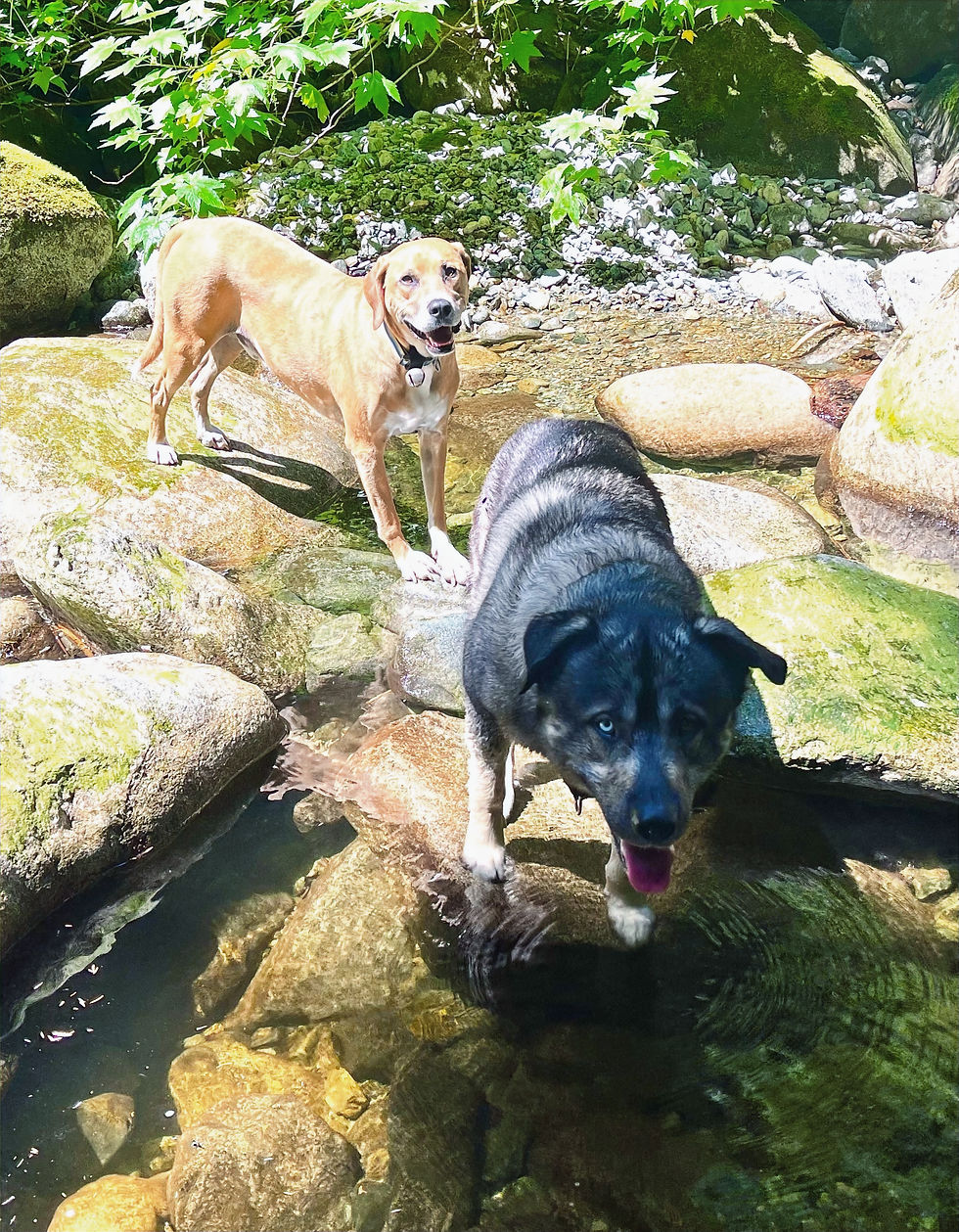
The riverside is lovely! Sully will retrieve his favourite squeaky ball in the glacier-fed river pools approximately three times in the peak August heat. A fourth throw constitutes an unauthorized amendment to the agreement, and the ball may remain part of the river’s permanent collection unless Bowie intervenes...and Bowie never requires a second request to recover a floating ball. On a sunny day between May and September, Sully will happily chill on a mossy rock by the river while Bowie spends every last minute dunking his ball in the icy cold river pools.
flexible distances
shaded walking
river meditation
endless sniffing
supervised river cooling breaks
opportunity to add/remove challenges
cold or fast-moving water early season and after rainfall
slippery moss-covered river stones
crowding near popular access points
wildlife (bears, bobcats, coyotes, deer and occasionally a transient cougar)
singled-coated dogs becoming chilled or fatigued after swimming.
Bowie:

Your retrieval limits are not recognized by this department. Keep the games coming until your arm is moving like cooked spaghetti. The cold river water is paws-down a double coated dog's recharging station.
Sully:

Three retrieves are enrichment on a hot day, the thick covered mossy rocks provide a memory foam cushion, and with the sun shining through and the soothing sound of water trickling over river stones, it's perfect!
Cypress Mountain: Three Levels of Dog-Friendly Adventure

Cypress is less one trail than a choose-your-own-adventure network. One junction can turn an easy forest reset into a moderate lake loop. Another can add steep descents, exposed roots, loose rock and a sudden need to remember whether everyone packed enough water.
Boundary note: Municipal forest trails and Cypress Provincial Park do not share identical dog rules. Follow current signs at every transition and leash up whenever required—or whenever wildlife, cliffs, fast water or questionable recall make the decision for you. (District of West Vancouver)
The Millstream Forest Reset
DIFFICULTY LEVEL: EASY


When I want a genuinely easy walk in the woods, I start farther down the mountain from Millstream Road and keep the outing simple.
This is a quieter, flatter forest option with soft ground, manageable roots and enough scent variety to satisfy the dogs without turning the walk into an agility assessment. My usual version takes about an hour, but it can be shortened when the weather, dogs or available daylight begin renegotiating the plan.
There are a few places for dogs to wet their paws when seasonal water is available, but the real appeal is the steady rhythm: mix of sun and shade, forest air and movement without constant scrambling.
A calmer trail can be exactly what a young dog, older dog or highly active dog needs between more demanding adventures.
Sniff-focused walks and lower-complexity days
Developing puppies & young adults learning varied terrain
Senior dogs who still want the forest vibe without their arthritic joints punishing them for days aftewards
Dogs building duration before adding technical terrain
Dogs practicing agility and recall skills with a bit more natural distraction
Guardians who want the forest air without an alpine entrance examination
Days when everyone would benefit from returning home with something left in reserve
Follow current signage regarding leashes
Keep dogs close and leash up when signs of wildlife exist (ie. dog lifts their head, nose is firing, hackles start to raise). Note: reliable recall is considerably less reliable after a bear or bobcat has entered the group chat
Wet sections after a rainfall and changing creek levels, especially in fall and winter.
Lack of amenities (though a garbage bin exists at the Millstream Rd entrance)
Sully:
There's soft ground, generous scent variety, a few decent sunny sections and no summit requirement. There's lots of side trails to take further down for an adventure detour, but this is a reasonable outing for for a 9 year old who needs a break day between bigger adventures.
Bowie:
Excellent scent inventory! Terrain could contain many more unnecessary side quests, and deeper creeks during hotter months... but I remain open to a reassessment. Ask me next week after it rains.
Kildonan–Ballantree and the Lost Lake Loops
DIFFICULTY LEVEL: Moderate

Brothers Creek and the cedar-heavy trails around Crossover, Baden-Powell, Kildonan and Ballantree are where I go when I want the forest itself to feel like the destination.
When I need a proper exercise session in 60-90 minutes paired with a fun, lightly rugged outing, I choose one of the many trail entrance points near the well known Brother's Creek trail access, and proceed to the Kildonan-to-Ballantree loop. I'd be lying if I didn't say I always take detours. There are so many to take but it is totally possible to do this loop in 45 minutes without detours. The mostly packed dirt, mulch and gentle rock terrain introduces some roots, natural debris, fallen logs and gentle-to-moderate inclines, and bridges over creeks while still providing easier sections between the challenges. There is enough variety to ask the dogs to think about their feet without requiring me to stare at mine for the entire walk.
With an additional hour, I extend through established but unnamed former mountain-bike trails northeast of Lost Lake Trail. While most of this area allows for leash-optional, I always wait a few minutes beyond the entrance before unclipping. There's a garbage bin at the main entrance for dog waste, but even if only 1 in 10 guardians decide not to pick up their dog's waste, that's a cumulative disaster for nature, (never mind a disgusting thing to step in). Please for the love of nature, and your fellow dog guardians and friends, pick up after your dog. Then bin, unclip and start your adventure.
Many of these extensions weave through quieter forest, moderate grades and natural obstacles before connecting toward Lost Lake. When time and energy allow, the lake becomes a welcome cooling stop before the return.
Jack Pratt to West Lake Trail: From a completely different access point, the Nordic lot in Cypress Park offers shorter routes towards West Lake or First Lake and can provide another easier option with groomed trails, surrounding forest, and seasonal berries to view with a little lake reward. Note that in Cypress Park, the entirety of it is on-leash only. There's a boundary between West Lake and Lost Lake that allows for leash optional if you trek up to West Lake from Lost Lake, but if you're parking in the Nordic lot, expect to keep your pup on leash the entire hike.
Creek access and lake options vary by route and season. Carry fresh drinking water regardless.
On-leash pre-adult easy terrain on Jack Pratt from the Nordic parking lot
Moderately conditioned adult dogs (past the growth phase) everywhere else
Dogs developing paw placement and trail confidence
Dogs with excellent recall in designated leash optional trails only
Guardians who prefer loops over retracing every step
Dogs that can settle briefly before becoming overtired
People seeking a flexible route that can grow with the available time

Wildlife especially late in summer
Warm-weather insects
Slippery roots after rain
Reduced creek levels in summer
Lost Lake and West Lake are great water dipping spots and the water is warm in the summer for dogs (and some adventurous people). The bug factor is high so do not plan on packing a picnic or else you'll see more black flies and mosquitoes than imagined. If I need to eat, I pack a protein bar, eat it while moving, and that's that.
The lake may feel like the finale; unfortunately, the return trip remains contractually binding so ensure your dog has built up endurance to match your trail duration.
Sully:
Balanced challenges, scenic perches, sun bathing opportunities, lots of agility practice and adventure. I find the arrangements entirely acceptable.
Bowie:
Varied challenges, lots of smells, side trails and detours, creeks and water holes, opportunities to quietly observe how a bear eats a huckleberry, and I get to travel 3 x farther than everyone else in the group yet keep everyone together-bonus paw!
Brothers Creek, Lost Lake & Black Mountain
DIFFICULTY LEVEL: Moderate & Moderate Plus

These are two very different styles of adventure: the forested ravine routes around Brothers Creek and the more exposed alpine terrain around Black Mountain.
Both options are beautiful. Neither should be treated as a spontaneous extension simply because everyone still feels energetic at the junction.
Route Option: Brothers Creek, Cross-Over, and Baden-Powell
DIFFICULTY: Moderate

It offers deep forest, varied more rugged terrain (uneven boulders, exposed roots, mulch, packed dirt, etc) wth creek access, old growth trees and numerous ways to create a longer loop.
From the lower network, a route can continue toward Lost Lake, Blue Gentian and Baden-Powell before returning through Brothers Creek and Crossover. It is one of my favourite areas when I want the forest (and side creek meditation stops) to be the destination.
It is also where trail awareness matters.
Along Brothers Creek between Crossover and the upper crossing area are steep ravine edges and cliff-like sections without continuous barriers. Several side trails descend toward waterfalls and cold-water pools, but not every visible path is an invitation—especially for dogs that enthusiastically travel ahead of the planning committee.
I strongly recommend leashing up before this section and travel through it together in both directions.
Rewards: that care with epic creek-steep ravine-ancient forest views, natural balance challenges and some wonderfully atmospheric places to pause. It can feel less like completing a trail and more like travelling through several different forests stitched together.
Scent exploration
forest bathing (old growth cedars and Douglas Firs)
adult dogs with excellent recall
agility and strength development
flexible and adaptable route lengths and difficulty levels
dogs who need shade, access to cool-off areas (along Brother's Creek)
weekday and weekend exploration
Unprotected ravine and cliff-like edges
Current bridge closures, detours and crossing conditions
Slippery roots, rocks and mud (in rainy months)
Dogs accelerating on steep descents
Jumping repeatedly from boulders or fallen logs
Wildlife and changing creek levels
The District often lists any bridge disruptions in the Brothers Creek network, so this is a location where checking current notices is not optional paperwork, although there are many alternatives around to have a great adventure. (District of West Vancouver)
These trails are also excellent places to practise controlled descents, and endless balance and agility skills, and there are a few precious sun-exposed sections that make the trek up worthy of multiple stretch and water reset breaks. Sully always takes this responsibility seriously and can locate a patch of sunshine with the efficiency of a solar-powered surveyor.
Sully:
Excellent moderate challenges with rewarding sections to practice balance, fallen tree climbing, rocky perches, enormous scent variety, and rewarding sunny perches including sitting by one of the swimming holes.
Bowie:
Shaded forest adventures with ample creek access points to dip the paws and a rewarding swimming lake to play one of my favourite games; sinking the unsinkable, fetching floaty latex frisbee, and working out some of the unrelenting power stored up by traversing 3 x more than my mom. This area never disappoints.


Your Dog May Be Travelling Further Than You
An off-leash dog rarely follows the trail in a tidy human line. While we walk from Point A to Point B, dogs zigzag between scents, investigate side trails and repeatedly circle back.
In one GPS pilot study, dogs travelled an average of 23% farther than their handlers, with one dog covering 2.6 times the human’s distance. That extra movement matters when assessing conditioning, hydration and how much energy remains for the return (Pfau et.al, 2011). Check out the study here.
Route Option: Black Mountain, Cabin Lake and Owen Lake
Moderate Plus

Starting higher in the Alpine area creates a different experience. Black Mountain offers more exposed terrain, steeper gravel, loose rock and considerably less reliable shade. The journey around Cabin Lake and Owen Lake provides excellent scenery and a rewarding alpine-lake destination, but the footing asks more from paws, carpal (aka wrist) ligaments while descending, balance and braking control with additional traffic.
This is a moderate-to-moderate plus dog hike even when the distance looks manageable on an app. It's moreseo due to the terrain on dog's paws, joints and tendons and lack of shade and water access for dogs who can overheat. The climb may be powered by enthusiasm, knowing the epic view that awaits on top. The descent is where movement quality submits its final report!
Generally plan for a 2 to 4 hour commitment including the drive to the parking area, and the routes selected, your pace, rest stops and detours.
There's little to no creek access en route up, and while there are a few lakes at the top for a quick or prolonged dip, always carry fresh water and do not rely on natural resources for hydration.
Note: Cypress Provincial Park and the resort’s hiking routes require dogs to remain leashed, and current trailhead signage always take priority. (BC Parks)
Those not looking for solitude on the ascent or descent
Well-conditioned, sure-footed adult dogs who hike well on-leash
Dogs that can follow a reliable Slow cue on descent
Dogs who can pass by other dogs on narrow paths without pulling you into an unscheduled play session
Dogs unfazed by other hikers using walking sticks, wearing different hats, or by groups of people
Guardians wearing proper footwear with excellent traction
Guardians prepared to turn around before the lake or viewpoint if movement quality changes

Cliff exposure at the peak
Loose footing
Warm weather mosquitoes, gnats and black flies (pack Trail Defence Veil)
Limited shade
Changing mountain weather
Cumulative fatigue on the descent (for older dogs or heavy chested dogs)
Pay attention to shortened steps, stumbling, scuffing, repeated root clipping, sideways descending, heavy front-paw landings or reluctance to continue. These observations tell you that adding more terrain is unlikely to improve the situation. Turn around.
Sully:

Rewarding sun-bathing perches at the top with respectable water dipping options for a quick cool off. It's less a forest adventure and more an exciting leashed walk and certain sections contain considerably more administration than I prefer. But, it the view at the top is pretty sweet.
Bowie:

A great glute and hamstring workout, I can gently pull my mom up when I'm in my expedition harness, outstanding multiple interactions with fellow canine friends, amazing smells and always a chance to see a few black bears foraging from a distance, and superior water hole cool off at the summit. Management’s insistence on keeping me on-leash and saying ‘Slow’ during our descent is irritating but, according to my wrists, legally defensible.
Our Favourite Sea-to-Sky Day Trip Adventures
Seaview Trail Near Magnesia Falls
DIFFICULTY: Moderate but Easy on Centennial Trail only
The Seaview-area forest trails are ideal for moderate movement, soft packed dirt, and mulch terrain with a steady incline, easy exposed root and very few boulder sections. There are side trail options to negotiate a longer descent or steeper quicker option with or without stairs. There's generous shade and the option to turn around before the outing becomes a formal negotiation. Sections of it are leash-optional, however I have seen black bears around those same trails over 50% of the time in summer months.
Depending on the route and current access, there's enough variety to keep a dog mentally and physically engaged without requiring continuous scrambling. Between Centenniel, Seaview and Trudi's Trail, you can create your own forest adventure for a pleasant afternoon hike, then stop at the Falls and head home...or, carry on a few more minutes down the Sea to Sky to finish the day off with a swim or paddleboard session or ocean swim at Porteau Cove.
Reward: Water Reset Station
The Crystal Falls and Magnesia Falls areas are less of an all-day destination and more of a spectacularly cold refreshment station, both before and after the hike. On a hot summer day, it is a beautiful place to dip your toes—or, in Bowie’s case, most of your body—into the icy pools near the base of the Falls.
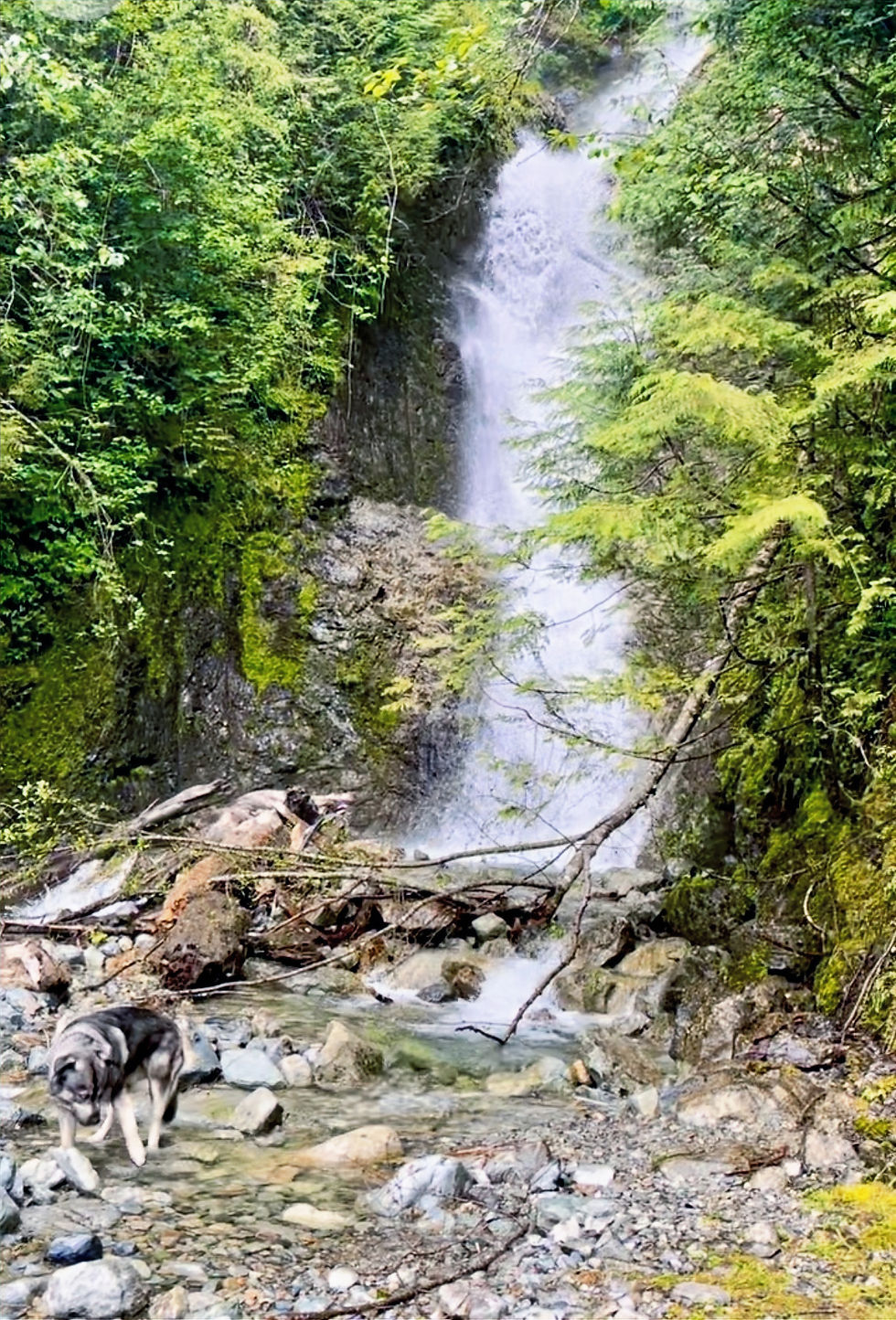
The Falls sit within a deep, densely forested ravine. It is stunning, shaded and atmospheric enough that I occasionally wonder whether a large feline is watching from somewhere nearby, quietly reviewing my route-planning skills.
Beautiful? Absolutely.
A place to spread out a picnic blanket and remain for four hours? Not so sure.
Moderately conditioned adult dogs
Guardians who appreciate flexible distances
Dogs that prefer continuous movement and intermittent inclines over starting and stopping throughout the hike
Dogs who can control the speed of their descent
Confirm the current access points
Temporary closures due to wildlife
Roots and rocks can be slippery on damp days and the rockes or damp sections can become slippery
Cold water may encourage enthusiastic dogs to stay in longer than sensible.
Turn around while your dog is still moving comfortably—not once fatigue has already changed their stride, posture or willingness to cooperate with management.
Unfortunately, Brunswick Beach nearby is not dog-friendly so coupling it with a beach swim requires driving a little further
Sully:
Sunny perch near the falls, interesting wildlife smells, an off-leash section and no summit requirement. Sensible planning.
Bowie:
Several side trails remain insufficiently investigated. Management should delay all final decisions until I have completed a full inspection. There may be no proper swimming hole, but I am highly adaptable and can create entertainment almost anywhere.
Tunnel Bluffs
DIFFICULTY: Moderate
Tunnel Bluffs offers a more substantial climb, mixed forest terrain and a dramatic viewpoint. It belongs at the upper end of this category rather than being treated as a casual forest stroll due to the combination of distance, elevation, varied terrain and the return descent can make the total physical demand considerably greater than the scenic photos suggest.
This is precisely the kind of trail where “my dog has done longer walks” is not enough information. The ability to cover distance on level ground does not prepare the body for prolonged climbing followed by controlled descending.
Well-conditioned adult dogs with sound movement (not dogs with osteoarthritis, stifle, hip or lumbar challenges)
Appropriate trail experience
Dogs conditioned for more endurance and varied terrain
Guardians prepared to manage the return journey with plenty of extra water
Wildlife
Slippery or awkward crossings
Changing creek levels
Front-loading or rushing on the descent
Keep dogs under close control around steep edges and on the steeper descents
Sully:

Sections of trails are absolutely five-paws! Again, I know I am a tough critic. The view is lovely, but there's not enough sunny stops along the way, the viewpoints my mom calls "pretty stunning" but she doesn't look comfortable crouching to enjoy it. Where’s the car? Where's my chewy? I'll wait here on the sunny perch while you fetch both.
Bowie:
Excellent. I have reviewed the descent and don’t recommend doing it at twice the responsible speed. Did it once, while charged with adrenaline and my wrist ligaments punished me for three weeks afterwards. Grateful my mom reminds me to go “Slow.” I absolutely love the waterfall and have no issue standing in the ice baths with towering ice spray cooling off my back. I just don't understand why nobody else joins me.
Jane's Lakes Trail
DIFFICULTY LEVEL: Moderate Plus
Janes Lakes is a fantastic warm-weather outings when I want a proper forest full day adventure. Sure, an experienced solo trail runner could get there in 45 minutes and but that's not the type of hike we are explaining here. There are two main ways to get here; the more advanced 18KM loop and the 11KM moderate-plus route which is not a loop, although you could loop around West Jane for added curiosity.
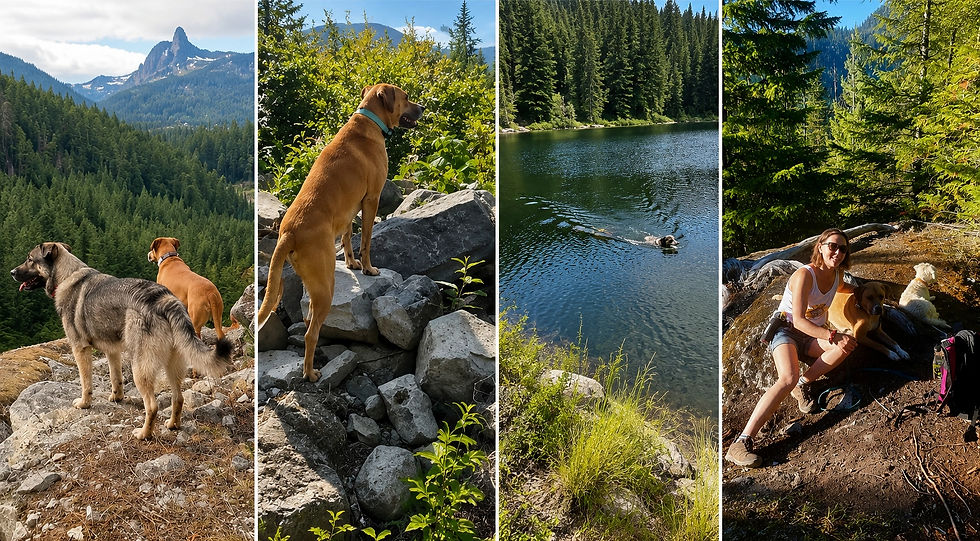
Most of the time, my dogs are on-leash for their safety, as wildlife is always nearby. This is what I recommend unless your dog is non-reactive around bears, grouse, hare and deer, and if your dog stays close to you, and who does not have a high prey drive. The route I take has no signage or amenities but there's cell service the entire route.
The longer forest marked trail on a trail app is fantastic and safer in terms of occasionally bumping into a fellow hiker..but its not the route I am reviewing here. The route I take is better for people trekking with a dog who need a bit more space and visibility to see ahead, for those that want a bit more solitude, and for those who do not mind a rugged, rocky and steep, tree-lined detour with access to one of the lakes. I cannot stress enough that the terrain is rugged and the lake is pristine due to the fact it will likely never become a busy party lake; effort, wildlife and the hungry insects keep the crowds low. It's not for everyone!
But if you pack right and come prepared, it can make for a favourite adventure easily. It's definitely mine. Either route terrain combines packed trail for rhythm and endurance, steady sustained incline for glute and hamstring awakening, with some rockier uneven sections that ask for more deliberate paw placement, balance and postural adjustment. The terrain softens again near and around the lakes, and it definitely feels more physically interesting than the distance alone suggests. It's less than 6KM each way but additional detours around the lakes make it longer - pick your challenge!
Each year, the small creek crossings have become fewer and now I can rely on two or three creeks with a decent trickle whereas only 7 years ago, there were a dozen still in the peak of summer.
Then comes the reward: The joy is swimming into the middle of the lake and realizing how lucky we are for so many outdoor gems. The peaceful water is warm enough for me in the peak of summer, and the beautiful alpine views never get old. The lake is surrounded by huckleberries, which the bears are nibbling on early in the morning, especially during August and September. I do find it particularly interesting that Bowie won't touch any fruit of any kind, ever, outside of peak huckleberry season. Most of the huckleberries he ignores, with the exception of a ripe black huckleberry. They are rarer to find, and prized by all bears and chefs alike. He carefully chooses one using his precise ripe-berry-detecting nose, and carefully plucks it off the branch.
Detour: Meet the large, union-minded northern breed mixed singleton who believes all family activities require his direct supervision in Meet Bowie The Union Steward

Moderately fit adult dogs (and guardians) that are comfortable with a sustained incline
Easily entertained by rugged terrain and valley views
Those who appreciate a quiet lake reward
Those not seeking additional signage or amenities
Those who can a few extra liters of water on hot days
Warm-weather insects
Wildlife activity
Changing creek conditions
Bring extra fresh water even when natural water is available
Remember that the return trip still exists no matter how convincing the lake is.
Sully:
A relatively warm lake has been provided, sun-soaked rocky perches, packed watermelon treats, and opportunities to swim, sun-bathe and take it all in. The arrangements are perfectly acceptable. I may swim around to see if there's a lakeside cabin we can move into permanently.
Bowie:
Excellent locally sourced catering, generous shade beneath the cedars and unlimited opportunities to retrieve sticks, pursue balls and swim after Mom so she can be firmly redirected toward shore.

Sully's Sun Chasing Detour
On one later-afternoon visit, the sun began slipping behind the far side of the lake. Sully, apparently unwilling to accept this scheduling error, started swimming toward it. He was not chasing a ball, retrieving a stick or responding to any recognizable canine assignment. He simply swam farther across the lake until he was little more than a tan punctuation mark in the distance.
Thankfully, his recall is excellent. He turned around and came back—although I remain convinced he was only returning to file a complaint about the premature loss of sunlight.
Jane Lakes West also activates the black-fly emergency broadcast system approximately three seconds after anyone opens a treat bag. Do not bring more than you absolutely need, eat it quickly or pack it back out. Leave no trace.
Mamquam Road and River Trails
DIFFICULTY: Easy
Not every adventure needs a summit, a detailed itinerary and enough equipment to establish a temporary base camp.
The Mamquam-area river and forest trails offer flatter but naturally rugged sections, riverside scenery and opportunities for a shorter cold-water reset. The surrounding network can provide additional exploration when time, access, trail conditions and the dogs’ energy permit.

This is one of my choices when I want nature without committing the dogs to a long technical outing. Roots, dirt, stones and driftwood keep it interesting, but the day can remain relatively simple and simple is definitely underrated. Choose only calm water access appropriate for your dog and use a leash or PFD vest for extra caution.
Short explorations
Riverside sniffing
Older puppies getting used to varied terrain without compromising joint development
Senior dogs who enjoy everything a big hike offers - but without the hike!
Changing river conditions
Slippery rocks in the creek
Seasonal or environmental restrictions
Wildlife activity
Sully:
Adventure does not always require a summit, epic scenery or expending calories. This sunny rock next to the river will do on this very hot day!
Bowie:
I have identified another route. Ok, it is not technically a route. Cold water, sticks, smells, shade and endless games. I'd give it an extra paw!
Cougar Mountain and the Showh Lake Region

For capable dogs, prepared guardians and suitable conditions, the Showh Lakes area around Cougar Mountain offers the kind of landscape that makes the extra planning worthwhile.
When approached on foot from the trailhead, this is a genuinely rugged mountain adventure—not a casual wander with scenic ambitions. Expect changing grades, exposed rock, uneven boulder sections, forest trails and enough terrain variation to keep every paw involved in the decision-making process.
Depending on current road conditions and the vehicle you are driving, it may be possible to continue partway toward the lakes. Without a properly capable high-clearance vehicle, however, the drive itself should not become the first obstacle course of the day.
This is not my “we have two free hours, one granola bar and reasonably good intentions” destination.
The reward is expansive mountain scenery, quieter lakes and a final passage through ancient cedar forest that can feel almost meditative—assuming everyone still has enough energy to appreciate it.
Well-conditioned, experienced adult dogs
Sure-footed dogs comfortable on rock and uneven terrain
Guardians prepared for remote conditions and a longer return
Dogs able to pace themselves rather than spend the entire physical budget before reaching the lake
Adventures where the vehicle, weather, people, dogs and plan all agree to cooperate
Check current access and road conditions before leaving. A vehicle being marketed as “sporty” does not automatically make it a rugged-terrain vehicle.
If hiking from farther down, account for the extra distance in both directions.
Rocky boulder sections can be unforgiving on paws, carpal joints and dogs that charge forward without brakes.
Shade can vary, and exposed rock absorbs heat. On hot, sunny days, I would not choose this outing for a heavy or double-coated dog.
Carry fresh water rather than relying entirely on the lakes, and plan more rest than your optimistic morning self believes will be necessary.
Wildlife awareness, navigation, communication and an emergency plan matter here.
Services are limited, phone reception may be unreliable and “we will figure it out when we get there” is not a great strategy.
Sully:
The hot sunny rock perches and mountain-valley views are enjoyable with lots of wildlife smells to keep adrenaline high. The lake is warm enough on a hot day, and finishing through the ancient cedar forest feels like doggy meditation.
Bowie:
I have reviewed the terrain and find the lack of convenience stores acceptable, although the extensive rocky boulder sections are unforgiving on my wrists. All forgiven once we reach the lake!
Build the Agility & Strength Before the Trail Tests Them
Moderate terrain asks dogs to place their paws carefully, control momentum, shift weight and adapt when the surface changes.
The trail should not be the first place those skills are introduced. Three to five short practice sessions during the week can be more useful than one heroic workout followed by four days of everyone pretending not to be stiff. The purpose is not to exhaust your dog. It is to make controlled movement familiar before nature adds roots, slopes, wildlife and somebody else’s off-leash adolescent Labrador.

I'm adding a few exercises to support preparation and conditioning for many of the trails included. Most importantly, work within your dog's capability and current limits. Confidence increases and ability matches terrain, and when the tails are wagging and ready for more the next day, I know I prepared my boys adequately.
Practise the Brakes: Slow, Controlled Descents
Controlled downhill walking practises pacing, trunk organization and management of forward momentum. It is particularly useful for dogs who believe gravity is a transportation service.

If your dog consistently front-loads especially after hiking downhill, read: What Is the Thoracic Sling and Why Does It Matter?
Practise Paw Placement: A Low Balance Beam
Use a broad, low and completely stable surface with good traction. A wide timber, low playground border or purpose-built beam can work when dry and safe.

Guide your dog across slowly. Reward individual paw placement rather than speed. Begin with three thoughtful passes and finish before balance deteriorates.
This encourages limb awareness, a narrower walking line and control around logs, bridges or rock corridors.
Note: do not increase height until they have mastered every grade prior. A low beam completed well teaches more than a high beam survived creatively.
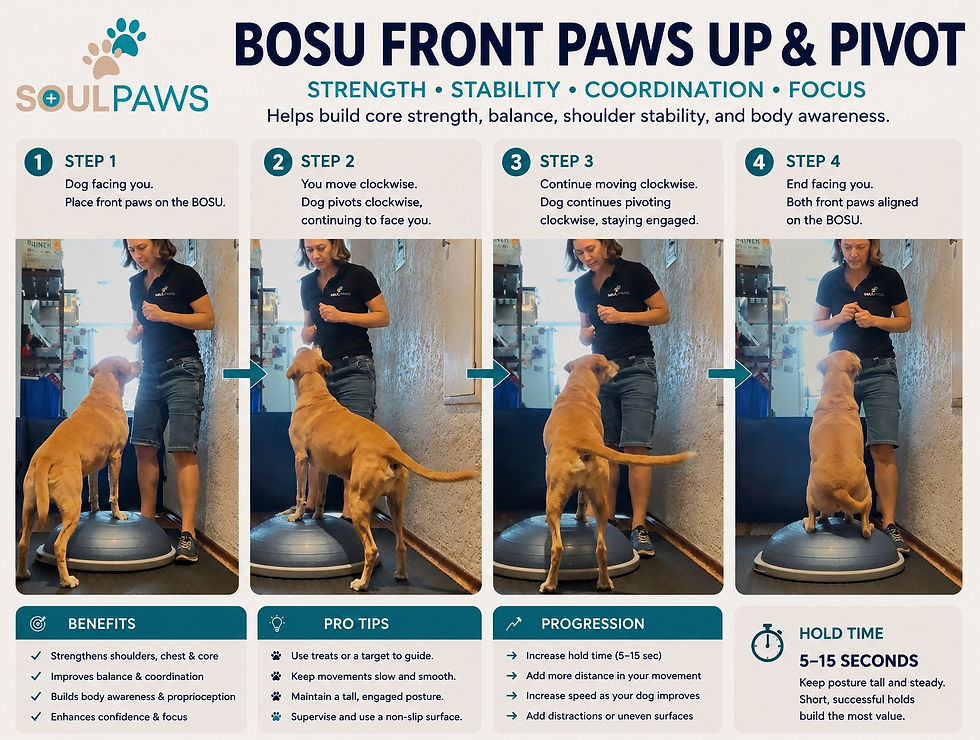
3. Practise Turning on Moderately Unstable Ground
The exercise asks the dog to shift weight, organize the trunk and reposition the hind limbs during a turn—skills that transfer well to tight trail corners and uneven surfaces.
Unstable equipment is a progression, not proof of ambition.
Everyday Agility Is Everywhere
An empty playground can become a surprisingly useful canine movement laboratory.
Low platforms, wide steps, poles and open pathways can provide opportunities to practise:
Moving under, over and around obstacles
Stepping onto low, stable surfaces
Pausing and holding a balanced position
Placing one paw at a time
Turning slowly in a confined space
Following a safe route instead of launching from the highest available object
The equipment does not make the exercise beneficial. The dog’s control does.
Keep the surfaces dry, stable and low. Use a leash where appropriate, avoid crowded playgrounds and never encourage a dog to jump from equipment designed for children rather than canine joints.
Sully learned the cues Under, Over and Around in controlled indoor environments before I began using them on outdoors, and then on trails.
That shared language now helps me guide him beneath a fallen tree instead of repeatedly jumping it, step around unsafe terrain and place his paws where I indicate when the obvious route is not the safest one.

Safety note: Dogs with pain, lameness, recent surgery, significant weakness, balance changes or known orthopoedic or neurological conditions need individualized veterinary or rehabilitation guidance before starting new exercises.
Want a tailored Exercise plan for your dog and live in the Vancouver area? For a Private Agility Coaching Session book here:
What My Dogs Know That I’m Still Learning
Sully knows that reaching a destination and experiencing it are not the same thing. When I say, “Find Our Spot,” he searches for a sunny log, mossy rock or scenic overlook—then waits for the mat, water and snack department to catch up. He reminds me that resting is not time stolen from an adventure. Sometimes it is the part that turns a walk into one.

Bowie knows the direct route is often missing the point. He notices cold creeks, hidden snow, wildlife trails and berry bushes I would have walked past. He can climb with extraordinary power, swim with unreasonable determination and turn every outing into a story containing at least one avoidable subplot. But enthusiasm is not pacing.

Bowie would happily spend his entire physical account before lunch, so part of loving him is helping him keep something in reserve for the return—and for the following morning.
Sully teaches me to stop, look around and smile.
Bowie teaches me to laugh and be creative to make a game out of anything.
Together, they remind me that the best adventure is not necessarily the one covering the most kilometres. It is the one where everyone returns home more connected—not simply more exhausted.

Adventure Smart — Before You Go
I have learned the hard way that a “quick local adventure” still deserves real preparation.
One day Sully stepped on a wasp several kilometres into a trail. Another time, a smaller dog picked up a tiny tick nymph, and thankfully I found it during a check before we drove home.
Prevention does not eliminate surprises. It simply gives you more options when they happen.
Before leaving, consider:
Fresh drinking water and a collapsible bowl
Food appropriate for the length and demands of the outing
A basic canine first-aid kit
A tick comb and suitable tick-removal tool
Paw-cleaning and minor skin-care supplies
A charged phone and offline route information
Identification and current contact information
A leash, even where off-leash travel may be permitted
A plan for wildlife, weather or changing river conditions
A dry towel or layer for dogs that become chilled after swimming
Enough supplies to manage an unexpectedly longer return

Your emergency plan should also match the remoteness of the destination. A riverside path near the city and a mountain lake reached by a rugged road are not the same outing simply because both appear under “dog friendly” in a search result.
Hydration Is Not Optional Equipment

Natural water may be cold, silty, fast-moving, seasonally affected or unsafe for drinking. Carry fresh water rather than depending entirely on what you expect to find.
Offer small drinking opportunities before your dog becomes frantic for water. A dog that is hot, highly aroused or intensely thirsty may drink too quickly or make poor decisions around the shoreline.
Plan for Wildlife Before Wildlife Appears
British Columbia’s beauty comes with wildlife. We enter their habitat, take in the scenery and return to urban life—sometimes only minutes away.
Keep food and scented items secured. Watch for posted notices and fresh signs of wildlife. Keep dogs close and leash them whenever wildlife may be nearby, even if the trail is normally leash optional.

The Best Adventure Is the One Your Dog Can Enjoy Well
Not every dog needs steep boulders, icy creeks or a dramatic summit photograph. Some dogs need packed dirt, shade, a slow sniffing walk and a soft place to lie in the sun.
The goal is not to do the most. Choose well, progress thoughtfully and build a dog who can keep adventuring comfortably for years.
Capacity Before Complexity
Bodywork and Movement Support
Is your dog ready for the adventure you have planned?
A Canine Bodywork Session can help identify areas of guarding, reduced tissue mobility, compensation or trigger-point sensitivity before you increase the challenge.
Private Trail-Preparation Coaching can help you choose and practise movement exercises suited to your dog’s current ability, goals and veterinary guidance.
Coming Next
Adventure Further: Part 3: The Water Dog -Adventures For Everyone


Comments