
Why Dogs Start to Look Like Their Owners
Updated: Mar 19

(No, It’s Not Just the Haircuts)
At some point, someone has probably said it to you:
“You know… your dog kind of looks like you.”
And once you hear it, you can’t unsee it. Maybe it’s the hair, maybe it’s the posture, or maybe it’s just the overall vibe—but sometimes the resemblance is so spot-on it’s a little unsettling.
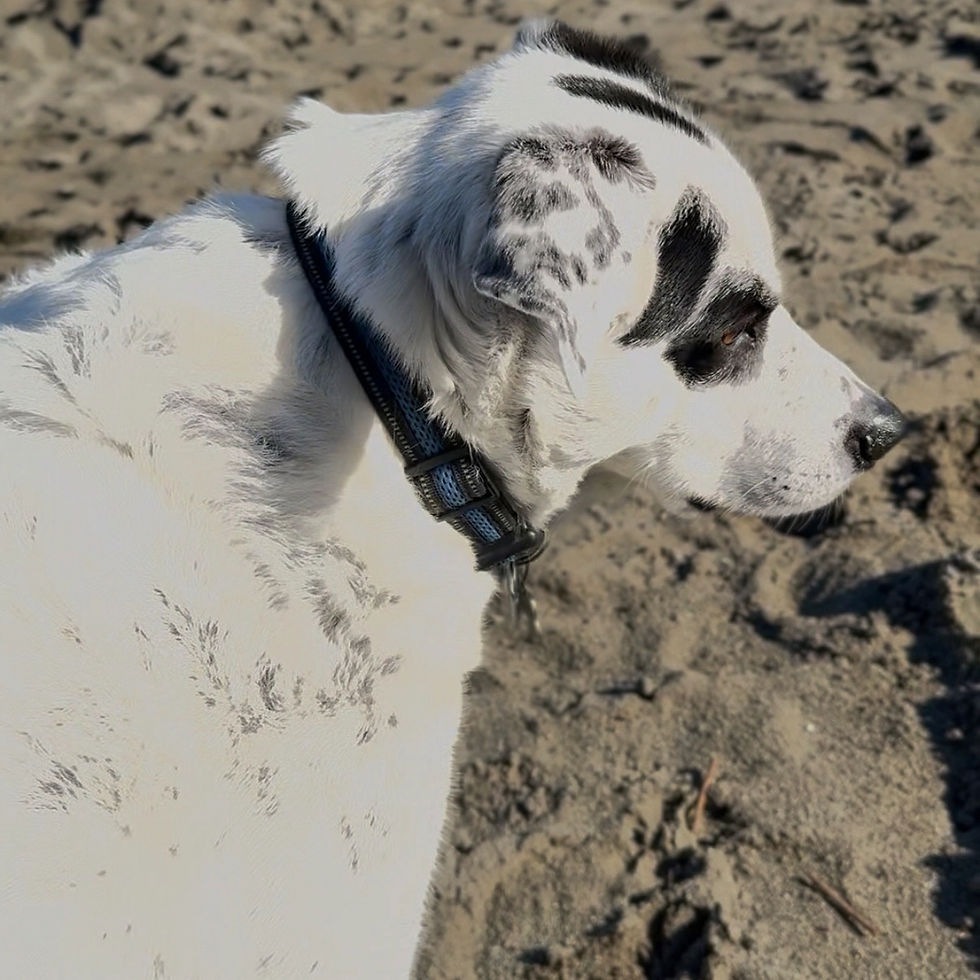
You start noticing it everywhere: the slow walkers paired with equally unhurried dogs, the anxious thinkers with alert, scanning companions, the beach gazers, the intense hikers, and of course, the ones who sit down, stare at the horizon, and seem to need a full existential reset before heading home.
(Yes, that one.)
So what’s actually going on here? Is it coincidence, selection bias, or just a shared appreciation for matching aesthetics—or are dogs genuinely becoming more like us over time?
Short answer: yes.
Long answer: yes… and it’s far more interesting than most people realize.
It Starts With Who We Choose (But That’s Only the Beginning)
Let’s get the obvious part out of the way first.
Research consistently shows that people tend to choose dogs who already resemble them in subtle ways—particularly in face shape, expression, and even perceived temperament. Round-faced humans often gravitate toward round-faced dogs, more serious individuals toward dogs with calmer or more reserved expressions, and active people toward dogs who look like they’ll happily keep up.
This isn’t vanity so much as familiarity. Our brains are wired to prefer what feels recognizable, even when we’re not consciously aware of it.
But that only explains the starting point, not the full story. What happens after years of living, moving, and regulating together is where things start to shift in much more meaningful ways—and that’s where it gets interesting.
(Roy & Christenfeld, 2004; Payne et al., 2015)
The Quiet Science of Co-Regulation

Dogs don’t just live with us—they regulate with us.
Co-regulation is what happens when two nervous systems continuously adjust to each other over time. It’s not conscious, and it’s definitely not intentional… it’s biological.
And it’s been studied.
Research shows that dogs and their guardians can synchronize heart rate, cortisol (that’s your stress hormone), daily rhythms, emotional responses, and even states of calm. What’s more fascinating is that in long-term relationships, this synchronization strengthens rather than fades.
Which means your dog isn’t just responding to what you do…
they’re adapting to how you exist.
(Sundman et al., 2019; Katayama et al., 2020; Schöberl et al., 2021)
Why Dogs Start Moving Like Their Humans
This is the part where practitioners quietly nod and go, “Yep… every day.”
Dogs don’t just learn commands—they absorb patterns.
They mirror walking pace, how often you stop, when you rest, how you recover, and even how you move through discomfort.
So if you:
move quickly → your dog likely develops a brisk, forward pattern
stop often → your dog pauses, scans, and waits
push through tension → your dog often does the same
And if you have a ritual? Your dog will absolutely adopt it.
One guardian I know had a quiet ritual: whenever there was a fire - a beach bonfire, backyard pit, campsite, or gas fireplace in a home, it didn't matter - she would sit down next to the fire, and warm up and often times watch the flames.
Over time, her dog adopted the same habit.
Now, no matter where they are, if there's a fire, her dog will find the closest possible spot to it, and lie down beside it...even if it's someone else's beach bonfire! It didn't matter whether that fire was starting to go out due to the rain falling, whether it was an entirely new location she had never been to, or whether the seating choice was dubious, at best - like balancing on the edge of a raised fire pit!

If there was a fire, this meant calm co-regulation time.
The ritual exists now. This wasn’t trained. It was not reinforced directly, but rather it was learned through shared stillness.
That’s co-regulation in motion.
Posture, Tension, and the “Same Energy” Effect
Dogs don’t just mirror emotions—they mirror bodies.
Chronic stress in humans often shows up as elevated shoulders, shallow breathing, jaw tension, and that classic forward-head posture we all pretend we don’t have.
Over time, dogs living alongside those patterns may begin to show their own versions: subtle neck and shoulder holding, changes in the thoracic sling, shorter stride length, or guarded movement.

Not because anyone did anything wrong…but because bodies learn together.
This is often why a dog can look “tense for no reason.”
There is a reason.
It’s quite likely shared.
If you see the dog across the street that you know your dog doesn’t have a friendly vibe with, your heart rate increases, and your dog feels that. Now your dog also sees that dog across the way. And now your dog can smell your cortisol spiking.. and now you’re thinking, “I’m not gonna say or do anything and we’ll get through this.” And then your dog reacts. But your dog reacted equally to your cortisol and heart rate while noticing the unfriendly dog across the street.
One Trick I do When I See a Dog I Know My Dog is Scared of and Will React:
Take a few deep breaths and exhale slowly and lower your shoulders and try to envision something in your head that makes you truly utterly happy. And if that is your own dog that makes you utterly happy, even better! Because now you can imagine you and your dog in your happiest moment and tell your dog how amazingly wonderful he is while prompting him into a sit (as you’re still taking some deep breaths).
As long as your cortisol is not spiking, and your heart rate stays neutral, you can reduce the chance by 50% that your dog will react, especially if there’s a good enough distance between your dog and that stimuli.
Give it a try. Your dog can really smell your stress hormones as much as you can smell a barrage of scents while walking through the perfume floor in a department store. And they truly can feel your heart rate vibrating through the leash like a 6.5 earthquake! Add a little tension to the leash, and bam! You’ll see fireworks.
Or try something different – and practice.
The Slow Drift of Personality Matching
Spend enough time together, and something else happens.
Dogs and humans often begin to share similar levels of intensity, tolerance for chaos, need for routine (or lack of it), and even styles of social engagement.
This isn’t projection—it’s feedback.
Dogs actively reference their humans when navigating the world. They check faces, posture, tone, even breath. Over time, that loop shapes confidence, caution, curiosity, and calm.
Dogs don’t just learn commands. They learn how you move through life.
(Merola et al., 2012; Albuquerque et al., 2021)
Why This Matters More Than We Think
This isn’t about blame—it’s about awareness.
When dogs carry tension, move inefficiently, or quietly compensate, it’s often not a random issue or sudden injury. More often, it’s part of a shared pattern that’s been building over time.
We tend to think of disconnection as something obvious - conflict, frustration, pulling on the leash...but more often, it's quieter than that.
It looks like walking together while paying attention to something else. A phone in our hand with our eyes down. (We're probably ALL guilty of this now and again!) A dog is at the end of the leash we're holding, scanning the environment alone, making decisions without us.
No tension. No drama. Just absence...but over time, that absence becomes a pattern too.

But here’s more good news: Since this process is biological—not moral—it’s also changeable. How?
When guardians slow their breathing, dogs soften.
When humans move with intention, dogs rebalance.
When care becomes consistent, bodies recalibrate together.

Practitioner Insight (Where I See This Daily)
After working hands-on with hundreds of dogs, one thing becomes very clear:
Dogs don’t just arrive with their own stories. They arrive with shared ones.
Movement patterns. Emotional habits. Ways of bracing. Ways of resting.
And when we support dogs gently—without force or urgency—we often end up supporting their humans too.
Because when humans soften- dogs don’t hesitate. They follow.
One of the more fascinating aspects of canine behaviour is just how quickly dogs can adapt to a new rhythm. In many cases, shifts in routine can begin within 24 to 48 hours—not because a dog has “forgotten” their structure, but because they are highly attuned to what is being consistently reinforced in their environment.

One of my favourite examples of this showed up during a week I spent dog sitting Vincent, a relentlessly adorable miniature dachshund I was working with already as a client (and who very quickly decided I was his temporary "person" while his parents had a long overdue vacation). His guardians had a beautifully consistent routine—early wake-ups, split breakfasts, everything dialled in. But within a couple of days, he began sleeping later, easing into the morning more slowly, and naturally aligning with my rhythm instead.
By the end of the week, he was happily snoozing well past his usual start time. When his guardians returned, so did the early mornings within 48 hours—not because he forgot, but because he simply readjusted to the rhythm around him.
Dogs don't just follow routines - they follow relationships.
This is part of why bodywork can be so powerful, especially when guardians are involved in supporting their dog’s overall well-being. Over time, I often hear the same feedback: dogs are not only moving better, but also appearing more relaxed, more settled, and in many cases, more affectionate after sessions.
It’s not just about the ear scratch, the post-walk treat, or a heartfelt “good girl”—although those absolutely matter (so please don’t stop). It’s about the deeper experience of feeling safe, supported, and physically at ease in their body.
And even when life gets busy—as it inevitably does—those consistent moments of care seem to carry forward. Dogs don’t keep score, but they do seem to hold onto the feeling.
So… Do Dogs Resemble Their Guardians?
Yes.
Not because of matching outfits.
Not because of haircuts or similar manicure and pedicures.
But because living together shapes nervous systems, movement patterns, and emotional habits over time.
It’s not mimicry, but rather - relationship.
And honestly… it’s kind of beautiful.
Sources & Further Reading
• Sundman et al., Scientific Reports, 2019
• Katayama et al., Physiology & Behavior, 2020
• Schöberl et al., Frontiers in Psychology, 2021
• Albuquerque et al., Animal Cognition, 2021
• Roy & Christenfeld, Psychological Science, 2004


You have a very readable analysis of the effects of a relationship between a guardian and their animal. It makes so much sense! I love the photos you have included! Your message invites us to really appreciate the relationship we have with our canine!